A low yield or slow conversion can have several explanations: the reaction pathway, temperature response, competing chemistry or transport. Running more experiments at convenient conditions does not necessarily tell them apart. The opportunity is to connect chemical understanding, measured data and the decision behind the experiment.
Simple to use · Autonomous engineering engine
Your problem. One connected workflow.
Bring the chemistry question and experimental data. SIA connects the modelling and analysis around the hypothesis, helping you choose the next experiment without stitching together a chain of scientific tools.
Start in plain language. Add the drawings or data you have. SIA handles model selection and tool orchestration, asking for the physical inputs that materially affect the answer.
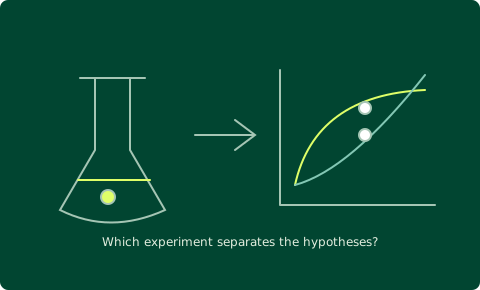
From your question to the decision
Start with the explanation to test
State the competing hypotheses and their observable consequences. Separate an intrinsic reaction-rate question from a mixing or heat-removal question before choosing the model or experiment.
Connect measurements to reaction behaviour
Use species balances and suitable kinetic models to interpret time-course data. Compare predictions with observations across conditions; fitting one dataset is a starting point for understanding, not the end of the investigation.
Choose the most informative next condition
Compare candidate temperatures, concentrations or sampling times against the uncertainty that matters. Choose an experiment that distinguishes the competing explanations, then use its results to update the model and improve the operating decision.
What changes the decision
Make each experiment inform the next decision. Connect chemical knowledge, measured results and engineering constraints in a continuous cycle of modelling, testing and learning.