A temperature prediction can satisfy a chosen equation while describing the wrong physical state. Near a phase boundary, pressure and enthalpy become central. Bulk phase split, evaporation rate and local boiling behaviour are related questions, but they are not interchangeable.
Simple to use · Autonomous engineering engine
Your problem. One connected workflow.
Describe the fluid state and the result you need. SIA checks the relevant properties and selects the model path so you can focus on process duty and operating choices rather than navigate property packages and solvers.
Start in plain language. Add the drawings or data you have. SIA handles model selection and tool orchestration, asking for the physical inputs that materially affect the answer.
From your question to the decision
Establish the state
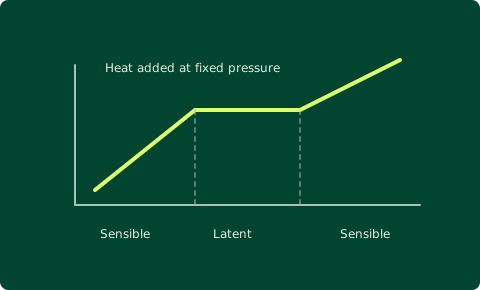
Use thermodynamic properties to check the inlet and target conditions. Distinguish ordinary single-phase heating from a path that reaches saturation or crosses into another phase.
Answer the bulk question efficiently
An equilibrium flash calculation can address an applicable bulk outlet-state or phase-split question. An enthalpy balance helps distinguish sensible and latent energy requirements.
Resolve transport when the question demands it
A rate, droplet lifetime or local wall question adds transport, geometry and often kinetics. Select those models explicitly rather than treating equilibrium phase split as a prediction of how fast the transition occurs.
What changes the decision
Start with the state and the decision. More detailed computation is valuable when it adds the physics the answer actually needs.