
03 / Computational fluid dynamics
The average
looks right.
Look inside.
A single reading cannot tell the whole story. Peel back the vessel and explore how flow, heat and material distribution shape the questions worth investigating.
RevealThe spatial behaviour
CompareAn operating or design choice
ValidateAgainst physical evidence
From anatomy to investigation
Ask a question.
Follow the heat.
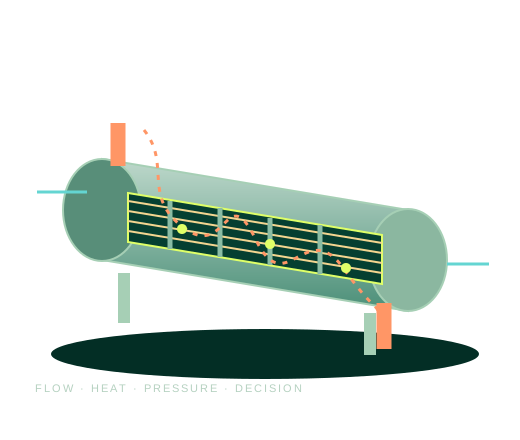
Open the shell-and-tube heat exchanger, change the datasheet and investigate pumping energy, throughput or fouling. Compare temperature, velocity and pressure fields, then inspect the evidence and assumptions.
Open the interactive lab ↗Simplified 2D porous-bundle CFD and engineering correlations run in your browser. Model scores and mesh comparisons are not independent validation. Verify operating and capital decisions against measurements and a validated engineering study.
01 / Peel back the physics
One vessel.
Five ways to see it.
Select a layer, then inspect a component. This is a conceptual anatomy, with illustrative fields rather than solved CFD results.
Reveal a layer
VESSEL / CUTAWAY
Illustrative anatomyStirred vessel · side section
Animation is deliberately slowed. Colours and trajectories illustrate concepts; they are not measured values or numerical predictions.
02 / Change one thing
Same vessel.
A different question.
Compare a baseline with a prepared conceptual alternative. Read the potential benefit alongside the trade-off.
Higher agitationCONCEPTUAL
What might improve?Stronger circulation can improve transport between regions. The result depends on impeller design, fluid properties and the flow regime.
What must be checked?Power demand, local shear and mechanical limits. More speed does not guarantee the best process outcome.
Prepared qualitative comparisons, not a live solver. No quantified performance improvement is implied.
03 / From an image to evidence
A compelling picture.
A defensible decision.
Represent the
real problem.
Geometry, material properties, inlet conditions, wall behaviour and the operating envelope define what a simulation can answer.
Interrogate
the solution.
Check conservation, convergence, mesh sensitivity and modelling assumptions before interpreting a coloured field.
Connect back
to the plant.
Compare against relevant measurements or experiments. Identify uncertainty and the controlled test needed before a process change.
The ResEt AI approach
Start where you are.
Go deeper where
it matters.
Operating history & experimental results
Use data analysis, kinetics and ML to investigate relationships and candidate operating choices. Spatial behaviour may remain unresolved.
Geometry & physical operating conditions
Assess whether CFD can answer a spatial question about flow, heat or transport. Select the physical models and simulation scope around that decision.
Simulation & measured evidence together
Calibrate where appropriate, validate predictions and compare alternatives within the supported operating range. Your specialists review the evidence and the next experiment.